

Why we hold onto attachments
Have you ever found yourself holding on to something so tightly, even when you know it's not really serving you anymore?
It might be a relationship, a job, a belief, a past experience, or even an idea of how you want your future to look. You might know, on some level, that it's time to let go, but something within you just doesn't want to. And sometimes, the more you try to release it, the more tightly you seem to hold on.
But what I've come to understand through my own healing work is that we don't get attached to people, things, beliefs or ideas simply because we want to. There's normally a much deeper emotional drive underneath, whether that's fear, safety, security, self-worth or a lack of trust.
And it's these hidden emotional patterns that we explored in the latest Soul Healing workshop, because letting go isn't necessarily about releasing the thing we're attached to. It's about releasing the emotional heaviness and stickiness we've wrapped around it.
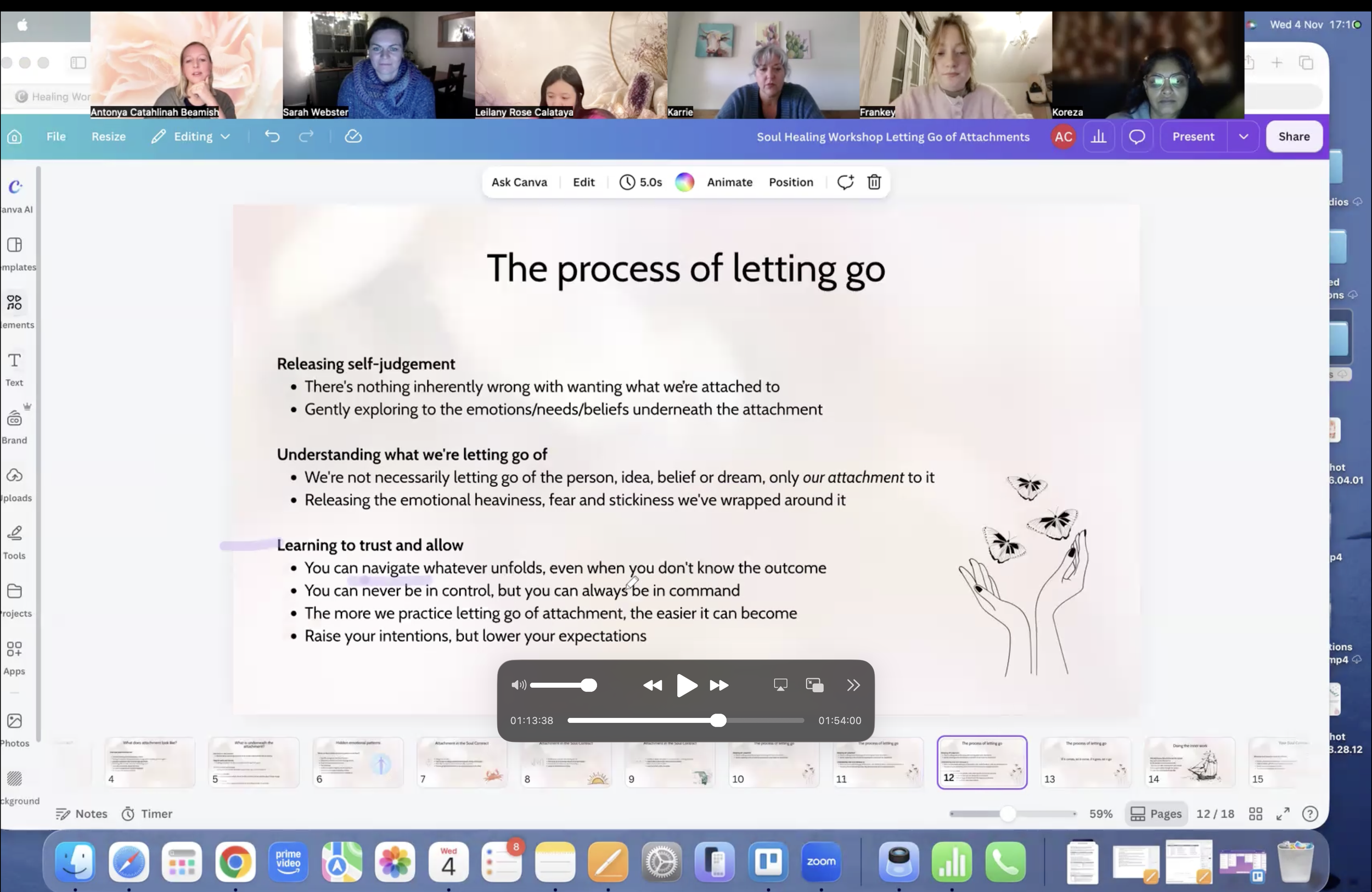
If you’d like to explore the subject in more depth, you can watch the full workshop below. Otherwise, I’ve pulled together some of the main ideas and teachings from the session in this article further below.
What are we actually attached to?
When we think about attachment, we often think about people, relationships or material possessions. But attachments are actually much broader than that, and some of the strongest ones are to things that don't even exist in our present reality.
We can become attached to a future dream, a particular outcome, how we think a relationship should unfold, or what we believe our life should look like in five years. We can become attached to our careers, our homes, our financial security, our beliefs and even our identities.
And something that I think is particularly interesting is that we can become very attached to past versions of ourselves.
I experienced this myself a few years ago. There was a time in my life when I was really into fitness and yoga, and I was very motivated to look after my physical body. But as my life changed, so did my priorities, and I found myself constantly comparing who I was now to who I'd been back then.
Why couldn't I be that person anymore? Why wasn't I as motivated? What had gone wrong?
Without really realising it, I'd become attached to an old identity, and that attachment was bringing up a lot of shame and judgement towards who I was in the present moment.
We can do exactly the same thing with the future. We imagine who we want to become, and then judge ourselves for not being that person yet. We're either looking backwards at who we used to be or forwards at who we think we should become, and in the process, we forget to be present with who we actually are!
Attachments can also develop around our past experiences, particularly those that have been painful or traumatic. Sometimes we hold on to what happened because we feel misunderstood, or because letting go might somehow mean that what happened was okay.
But releasing our attachment to a painful experience doesn't mean we're saying it was acceptable, or that our feelings weren't valid. It's about acknowledging the emotions that are still tied and locked into that experience, rather than continuing to carry all that emotional heaviness with us.
How attachment keeps us stuck
One of my favourite ways of explaining attachment is to imagine looking up at a beautiful night sky full of stars.
There are thousands of stars above us, but we've become completely focused on just one. That one star represents the thing we want, the relationship we're hoping for, or the future we're trying to create. And because we're so focused on that particular star, we can't see any of the others.
That is exactly what attachment does - it puts blinkers on us. It narrows our vision and keeps us focused on one very specific person, idea or outcome, often to the exclusion of everything else that might be available to us.
As a result, we can become quite rigid, inflexible and controlling in the process. We want things to unfold in a certain way, at a certain time, and when they don't, we can feel frustrated, disappointed, angry or resentful.
We might find ourselves constantly overthinking, analysing all the different possibilities and trying to work out what will happen next. The ego-mind loves to do this. It's always seeking to control, always asking, what if this happens? But what if that happens?
And my goodness, it can be exhausting!
Sometimes attachment keeps us somewhere we no longer want to be, simply because we don't know what will happen if we leave. We might stay in a relationship, a job or a way of being that doesn't feel nourishing anymore, because the alternative feels too uncertain.
But when we begin to loosen that attachment, something rather lovely can happen.. we start to see all the other stars again. The possibilities, opportunities and different ways forward that we couldn't recognise before begin to feel more available to us. We move away from that rigid energy of control and force, and begin to experience a little more freedom, flexibility and flow.
What's really underneath our attachments?
This, for me, is where the most interesting part of the work begins. Because rather than judging ourselves for being attached to something, or trying to force ourselves to let it go, we can begin to ask a different question.
What is this attachment giving me emotionally, and what am I afraid might happen if I release it?
For some of us, the answer might be fear of loss. We worry that if we let go of something, we'll lose it forever, and nothing will come along to replace it. It's a little like standing on the edge of a cliff, holding on to a rope. We know that our hands are hurting from gripping it so tightly, but we don't know whether there's going to be another rope to catch us if we let go.
So we keep holding on.
For others, attachment is connected to a need for safety and security. Perhaps we've experienced situations where we trusted someone or something and were let down. We may have learnt that the only way to feel safe is to manage everything ourselves, or to know exactly what's going to happen before we take a step forward.
Sometimes there's a lack of trust underneath. Whether it’s that we don't trust ourselves to handle whatever unfolds, or we don't trust other people, life, God or the universe to support us through change.
And sometimes, underneath our attachment, is a question of self-worth. I talk about self-worth a lot in my work because I think it's such an important foundation of how we experience ourselves and the world around us.
At our core, I believe we are all inherently worthy. But through our experiences, conditioning and the environments we grow up in, we can forget that worthiness and begin to attach our value to things outside of ourselves.
The difference between self-worth and self-esteem
This is where I like to distinguish the difference between self-worth and self-esteem.
Our self-worth is the foundation of who we are, whereas our self-esteem can become connected to external things, such as what we look like, the work we do, how much money we earn, or how other people perceive us. And when those external things disappear or change, our self-esteem can tumble.
Perhaps a relationship makes us feel beautiful and loved, and without that person, we worry that we won't feel beautiful or loved anymore. Or perhaps our career gives us a sense of meaning and purpose, and we fear that without it, we'll somehow become meaningless or purposeless.
We can become very attached to the things that appear to be feeding our sense of value. But the more we begin to recognise and build our self-worth from within, the less dependent we become on those external things to tell us who we are.
And I think this is a really important part of letting go. It's not about deciding that we no longer want love, success, security or meaningful work. It's actually about understanding why we feel we need those things in order to feel okay within ourselves.
How our Soul Contract can influence attachment
Something I also like to explore in my work is how our Soul Contract can influence the emotional patterns we experience throughout our lives.
Within Soul Contract work, there are certain energies that I particularly associate with attachment, although they can express themselves quite differently depending on where they sit in someone's chart and what else is happening in their life.
The 8-8 energy, for example, can be very emotionally and mentally attached. People with this energy can be deeply empathetic, feeling what's happening for others around them and sometimes taking on a burden of responsibility to help, fix or support everyone, often at their own detriment.
There's a beautiful lesson here around grounding, boundaries and learning to recognise what belongs to us and what doesn't. We can still feel connected to other people and care deeply about them without absorbing everything they're experiencing into our own energy.
The 11-2 energy is very connected to transformation, letting go and rebirth. One of its lessons can be learning to trust ourselves and build emotional resilience, particularly when past experiences have left us feeling unsafe or uncertain about whether we can manage things on our own.
And then there's the 4-4 energy, which I associate with feeling worthy to receive. Sometimes this energy can struggle to trust that something new will come along, and so it holds on very tightly to what's already there. It's a little like being stuck in a traffic jam, knowing there's another road you could take, but not trusting that it will actually get you where you want to go. So you stay where you are, even though you're not moving.
Of course, our Soul Contract is only one part of the picture. We can also carry patterns from our family, our upbringing, past experiences, emotional trauma and, from the perspective of the healing work I practice, energetic imprints held within the soul.
There can be quite a lot going on underneath a single attachment, and sometimes several emotional patterns are all interlinked. So if letting go feels particularly difficult, it's worth remembering that you may be working with something much deeper than simply not wanting to release a person, idea or situation.
Learning the difference between control and command
One of my favourite metaphors, which I use quite often in my workshops, is the idea that we are all the captains of our own ships.
Imagine you're standing on the deck of your ship, wearing your captain's hat, looking out at the open water. As the captain, you're in command of your vessel. You can look after it, prepare it, maintain it and make decisions about how you're going to navigate the journey ahead.
But what you cannot do is control the ocean. You can't control when a storm will arrive, how high the waves will become, or whether a thick fog will suddenly appear in front of you. And this is very much like life.
We can spend an enormous amount of energy trying to control what's happening around us, how other people behave, what the future will bring and whether everything will unfold according to our plans, but ultimately, we don't know what's going to happen.
What we can do is take command of ourselves.
If we're sailing into thick fog, we can hang lanterns on our ship, put on our life jacket, make sure our vessel is in good condition and prepare ourselves as best we can. But we cannot make the fog disappear simply because we don't like the uncertainty.
And I think the same applies when we're moving through change in our lives. We can nourish our bodies, look after our physical and emotional well-being, connect with the people who support us, work through our fears and develop a deeper understanding of ourselves.
The more intimately we know ourselves, the more we can begin to trust our ability to navigate whatever unfolds. Rather than immediately reacting, panicking or going into a crisis whenever something unexpected happens, we can begin to respond from a place of greater calm and knowingness.
And I think this is where trust becomes so important.
Trust isn't something that magically appears because we've done a little bit of inner work. I often describe trust as being like a muscle. If we've never really used it, or our trust has been broken in the past, we may need to build it gradually. And that can begin with really small things.
Trusting ourselves to make a decision, trusting that we can navigate a change of plans, or simply trusting that we'll know what to do when the time comes. We don't need to begin by making enormous life-changing decisions. We can practice trusting ourselves in our everyday experiences, and gradually build that inner knowingness that whatever happens, we'll find a way to navigate it.
Raise your intentions, but lower your expectations
One question I've explored a lot in my own life is how we find the balance between surrendering to what wants to happen and actively creating the things we want.
Because we are here to create. We're here to co-create through our physical bodies, to experience life and to bring our ideas, dreams and desires into reality. But where is the line between taking action and trying to force an outcome?
I don't think there's one perfect answer to this, and I'm certainly still learning how to find that balance myself! But something that's really helped me is the phrase: raise your intentions, but lower your expectations.
For me, there's a big difference between an intention and an expectation.
We can set an intention for something we'd love to experience or create, and take meaningful steps towards making it happen. But when we become attached to exactly how it needs to look, when it needs to arrive, or how we think it should unfold, that's when we can slip back into trying to control everything.
It's also that lovely balance between leaning forward and leaning back. If we're leaning too far forward, we're constantly striving, pushing and questioning when things are going to happen. But if we lean too far back, we can become completely passive, waiting for life to deliver something without actually doing anything to help create it.
Sometimes we need to pick up the phone, write the email, put ourselves out there, or simply take the next step towards something we'd love to create. It's about coming out of passivity and into action, but not into force.
Letting go of the attachment, not necessarily the thing itself
This is probably the most important thing I want to share about the process of letting go - we're not necessarily letting go of the person, the relationship, the dream, the belief or the thing we want - we're letting go of our attachment to it.
I like to imagine an attachment as something wrapped up in layers of sticky cling film. Underneath is the person, idea or dream itself, but surrounding it is all this sticky emotional energy, the fear, expectations, insecurities and beliefs we've wrapped around it. And the more tightly we hold on, the more tangled and rigid everything becomes.
When we begin to understand and work through the emotions underneath, it's a little like slowly peeling away those layers of cling film. We're not trying to destroy or remove the thing underneath. We're simply clearing some of the emotional heaviness surrounding it, so that our relationship with it can begin to feel lighter, smoother and less entangled.
And this is why I think releasing self-judgement is such an important part of the process.
There's nothing inherently wrong with wanting a relationship, financial security, a beautiful home, a fulfilling career or a particular dream to come true. We don't need to feel ashamed of our desires, or judge ourselves for becoming attached to them.
Instead, we can bring a little more awareness, understanding and compassion to what's happening underneath.
Perhaps there's a fear of abandonment that needs acknowledging, or grief from a past experience that hasn't yet been fully processed. Perhaps we've become dependent on someone else's approval to feel worthy, or perhaps there's a part of us that simply doesn't trust that we'll be okay if something changes.
And sometimes, just recognising what's actually going on can be the beginning of a shift.
Of course, this doesn't mean that letting go is always easy. Some attachments are deeply connected to our past, our identities and experiences that have shaped us for years. There may be layers of grief, anger, fear, denial or resistance that need time and space to be acknowledged.
So I think we need to give ourselves a lot of grace with this work.
We're all a work in progress, and we don't have to become perfectly unattached human beings who never feel fear or uncertainty. My goodness, that would be quite a challenge. But we can begin to notice when we're holding on a little too tightly, explore what's underneath, and gently allow some of that emotional stickiness to soften.
Making space for what wants to come
One of my favourite phrases comes from Tosha Silver's book Outrageous Openness where she says "let what wants to come, come, and let what wants to go, go."
I think there's something rather beautiful about that. Because when we're attached to something, we often believe that holding on is what will keep it safe. That if we can just manage everything carefully enough, we can prevent things from changing, disappearing or unfolding differently from how we'd imagined.
But life is constantly moving and changing, and so are we.
Sometimes the things we're holding on to are still very much meant to be part of our lives, and releasing the attachment simply allows us to experience them with greater ease and freedom. Other times, something may have served its purpose, and perhaps there's something else waiting for us that we haven't yet been able to recognise.
We don't always know, and I think learning to be okay with that uncertainty is part of the journey.
For me, letting go isn't about giving up on our dreams or becoming indifferent to the things and people we love. It's about learning to hold them a little more lightly, without needing them to define our worth, our happiness or our sense of safety.
And the more we understand ourselves, the hidden emotional patterns that shape our attachments, and what we genuinely need to feel supported within ourselves, the easier it can become to loosen our grip.
We can still set our intentions, take action, love deeply and create beautiful things in our lives, but perhaps we can also allow ourselves to be a little more open to the other stars in the sky, trusting that we don't need to know exactly what comes next in order to take the next step.
Further Support & Resources
If you’re navigating emotional challenges or feeling weighed down by old patterns, here are a few gentle ways to support yourself:
Join the next Soul Healing Workshop
Come and explore the deeper emotional patterns, hidden in the Soul Contract, driving your behaviours.Discover your Soul Contract
Gain insight into the hidden patterns shaping your reality, and understand why certain emotional themes keep repeating in your life.Stay connected
Join my newsletter for monthly updates alongside the latest insights from the blog.
Carry on exploring





Explore why we hold on to people, beliefs and future outcomes, the hidden emotional patterns behind attachment, and how letting go can bring more freedom, joy and grace.