

The Hidden Roots of Self-sabotage and Perfectionism Within the Soul Contract
Unpacking Self-Sabotage, Perfectionism, and the Soul Contract
Welcome to this wonderful conversation about self-sabotage and perfectionism.
If you’ve found your way here, this was a workshop I hosted (and I run them every month on different themes) exploring the Soul Contract energies behind self-sabotage and perfectionism. What unfolded in that space was not just a conversation about self-sabotage, perfectionism, and avoidance, but something much deeper and more intimate.
It became an honest exploration between the two of us on the workshop as to why these patterns exist, and why they can feel so difficult to name, let alone shift.
Because the truth is, self-sabotage is not always obvious. It doesn’t always look like procrastination or outright avoidance. In fact, it’s often far more subtle than that. It can feel like part of our personality, something woven into the fabric of who we are. It can feel familiar, even comfortable, which is exactly why it’s so hard to catch.
In the workshop, we described it as trying to catch a fish moving beneath the surface of a river. You know they’re there and you can sense them, maybe even glimpse their movement, but they’re slippery and hard to grasp. And every time you think you’ve got hold of one, it disappears again!
That is what self-sabotage feels like. It lives under the surface, quietly influencing the direction we move in, often without us even realising. And what makes this even more complex is that self-sabotage is not random.
It is not a sign that something is wrong with you. It is, in many ways, a form of protection. There is always something underneath it, whether it’s a belief, a fear, or an emotional pattern, that is trying to keep you safe. And until we understand that, we can end up stuck in the loop of noticing the behaviour but never truly shifting it.
This is where perfectionism comes in, because perfectionism and self-sabotage are so often intertwined.
And before we dive in, if you're curious about your own Soul Contract, you can explore your unique patterns, gifts, challenges and potential through a personalised Soul Contract Report. Available as a short Summary or an in-depth Full Report, with prices starting from £16.

The hidden emotional roots of perfectionism and self-sabotage
Perfectionism is one of the most socially accepted forms of self-sabotage. It looks productive and admirable - it can even look like success - but underneath that polished surface, there is often a very different story unfolding.
Perfectionism can show up as the need to do everything yourself, the reluctance to receive support, or the sense that you are carrying more responsibility than you realistically need to. It can show up in overthinking, over-analysing, and placing immense pressure on yourself to get things “right.”
And perhaps most tellingly, it can show up as not starting at all, because the idea of doing something imperfectly feels too uncomfortable.
There is something deeply vulnerable underneath perfectionism, despite its tough exterior. It is often rooted in the belief that if you can just make everything perfect, no one will see the parts of you that feel flawed or not enough. It is like constantly patching over a crack, making sure it is hidden from view. But that effort comes at a cost.
It creates tension, pressure, and a constant sense that you are never quite reaching the standard you have set for yourself.
When we begin to look beneath both perfectionism and self-sabotage, we start to find the emotional roots. So often, these patterns are shaped early on. Many of us grew up in environments, and cultures, where love, attention, or validation were linked to what we did rather than who we were. Achievement became a measure of worth, which is reflected in our society’s values in such a strong way.
And from that, a belief can form quietly but powerfully: that we need to work hard in order to be loved, accepted, or valued. And, ultimately, in order to feel safe.
That belief does not stay in childhood, it actually moves with us into adulthood, shaping how we show up in our work, our relationships, and our sense of self. It can create a constant internal pressure to do more, be more, and prove ourselves, even when we logically know that we are already enough.
The sneaky side of self-sabotage: staying busy but not moving forward
What makes this even more challenging is that self-sabotage does not always look like doing nothing. In fact, it can often look like doing a lot.
It can look like staying busy, being productive, organising, planning, and completing tasks that give us a sense of control or accomplishment. But if we are honest, those actions can sometimes be a way of avoiding the one thing that really matters.
This is where self-sabotage becomes particularly sneaky. We can convince ourselves that we are moving forward, that we are making progress, when in reality we are circling around the very thing that feels uncomfortable. We stay in motion, but we are not actually moving in the direction we want to go. Self-sabotage is a way of tricking ourselves and staying in avoidance of the one thing we really need to do.
At the heart of all of this, there is often fear. The fear of failure is one that many of us recognise. It is the fear of getting it wrong, of being judged, of not being good enough, or of disappointing others. And because that fear feels so intense, we can choose not to try at all.
But there is another layer that is often less visible, and that is the fear of success. Success can bring visibility, responsibility, pressure, and expectation. It can ask more of us. It can stretch us beyond what feels comfortable. And for many of us, that does not feel safe.
There can be a quiet question underneath it all: can I handle this? What if I burn out? What if I cannot sustain it? What if I am not actually good enough for that level? These questions can create a subtle resistance to stepping fully into what we say we want. And so, we hold ourselves back, not because we do not desire success, but because of what we believe it will require from us.
Understanding self-sabotage through the lens of the Soul Contract
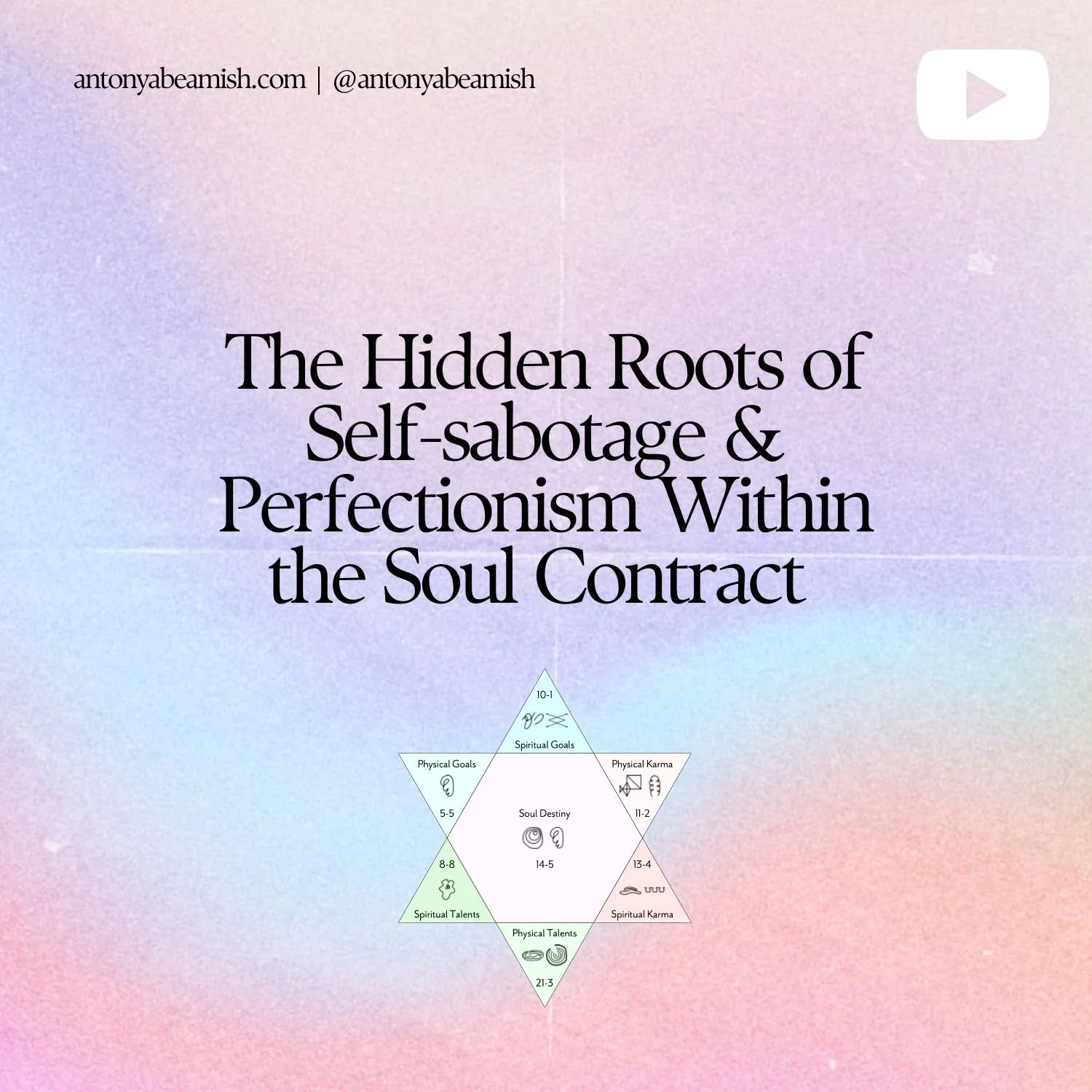
This is where the idea of the Soul Contract (created through the sound of your name) offers another layer of understanding - and if you watch the workshop here you’ll be able to see what key Soul Contract energies are connected to self-sabotage and perfectionism.
Or, if you prefer to read, here’s a handy guide of ‘The Hidden Themes of Self-sabotage in Your Soul Contract’ which you can read here.
Through looking at the Soul Contract, it invites us to look beyond just our current experiences and consider that some of these patterns may be part of a deeper energetic blueprint. Certain tendencies, such as hiding, overworking, struggling with self-worth, or fearing visibility, can be seen through this lens as part of a larger journey of growth and awareness.
This perspective does not mean that we are fixed or defined by these patterns. Instead, it helps us see that there is meaning in what we are experiencing. It allows us to approach ourselves with more compassion, rather than judgment, because we begin to understand that these patterns are not failures, they are part of a process.
And this leads into one of the most important shifts that came through in the workshop. Healing is not about getting rid of these parts of ourselves. It is not about eliminating self-sabotage or perfectionism entirely. It is about softening our relationship with them.
So often, we think healing means letting go, pushing away, or moving beyond. But in reality, healing is about allowing. It is about recognising the parts of ourselves that we resist and learning to sit with them, understand them, and integrate them.
When we resist these parts, they tend to become stronger, but when we meet them with curiosity and compassion, they begin to soften. And in that softening, there is space for change.
The work, then, is not to become perfect or to never self-sabotage again - it is to become aware. To notice when these patterns arise, to recognise what is underneath them, and to respond differently. It is about building a relationship with yourself that is grounded in understanding rather than criticism.
Because the truth is, this is not something you are alone in. Self-sabotage, perfectionism, and avoidance are universal experiences. They are part of being human, and part of navigating life in a world that often places pressure on us to be more, do more, and prove ourselves.
But within that, there is also the opportunity to choose a different way. A way that feels gentler, more compassionate, and more aligned with who you actually are. And that begins, simply, with awareness.
Carry on exploring







Why do you feel overwhelmed all the time? Explore the hidden emotional patterns behind overwhelm, from people-pleasing and perfectionism to control and over-giving.